dead hedgehogHey guys, so as someone working as a volunteer in a hedgehog rescue center, I wanted to write a post here that would help you attract hedgehogs to your garden, but also help you to recognize when there may be a problem with a hedgehog and you should act in order to help the animal.
DOs and DONTs
- DON’T: Absolutely NEVER give milk to hedgehogs – it is DEADLY, their bodies cannot process milk, please never ever give milk.
- DON’T: once you have a hedgehog in your garden, do NOT block its way out, it is forbidden by law to do this
- DON’T: give mealworms to hedgehogs – in high quantities, the worms can lead to metabolic bone disease, which is deadly and very painful
- DO: Place a heavy, clay/glazed dish with water year-round for hedgehogs to drink. Even in winter, they sometimes wake up and need water. Also helps birds. I use a bird bath for this

- DON’T: Never pick to save a hedgehog in the summer period who may be a female and may have babies dependent on her, unless super urgent. Always call a rescue center first for advice.
- DON’T: If you find a mother with babies, DO NOT TOUCH the babies, under any circumstances. This can cause the mother to not only leave them, but sometimes even kill them because they smell like something she doesn’t recognize anymore.
- DO: If you absolutely must intervene to save a mother or a hoglet, always use thick gloves, never touch a hedgehog with your bare hands. Touching with bare hands may cause irritation to your skin. First secure the mother, then the babies. Put them in separate boxes until they get to the rescue center
- DON’T: If you find a nest with babies and a mom, do not disturb them, do NOT open the box, better if you want to see what’s going on, buy a wifi or a security camera and place it outside and observe this way, I do that and it’s a lot of fun. See the section for cameras to see what i use. Mothers, when stressed, kill and eat their babies (very cruel, but it’s better than a male hog or a predator to do this). Males also often kill the babies, even if they are their own; they just detach and don’t take care of the babies, therefore they don’t know it’s their babies, but they DO want to mate with the female again, so they do this.
How to encourage hedgehogs to your garden
In the Netherlands specifically, the food options for wild hedgehogs are very limited due to the shortage of housing, which means more nature is claimed for housing, less is left for wildlife. People add more and more tiles to their gardens for easier maintenance, also many people place fences reaching the ground, meaning hedgehogs cannot go inside these houses. So it is actually encouraged for people to leave a dish with dry cat food outside for the hedgehogs. However, all the roaming cats would eat that food, of course. This is why you can make a very simple hedgehog restaurant in your garden, out of a plastic box and a φ12 cm pipe. See the instructions in the section for it below.
In my home country Bulgaria, for example, it is not recommended to feed hedgehogs, as this makes them dependent on people and we have plenty of nature and food for them. So please do not feed if you live in a country that is not The Netherlands unless recommended by rescues due to reasons similar to what we have in the Netherlands.
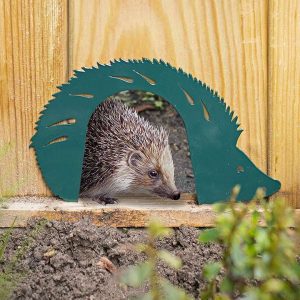
If you want to have hedgehogs in your garden but have a fence, you can buy a hedgehog “door” and make a hole in your fence for the little prickly friends. Then they can come and go as they please. You don’t necessarily have to feed them, but you do increase their chance for finding food just by allowing them to forage for food on your territory 🙂
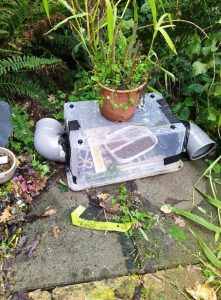
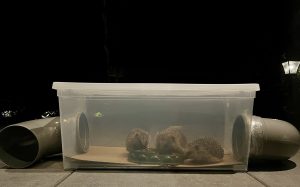
Hedgehog restaurant
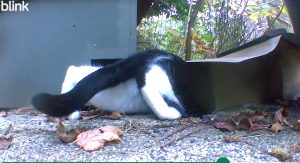
For a hedgehog restaurant, you can use a plastic box and put a φ12 cm pipe as an entrance tunnel. It is recommended to have 2 exits as food can attract multiple hedgehogs and they can become very vicious in their fights, potentially one wounding the other, so there should be a second exit to allow for one of the hedgehogs to escape. And also against predators. See the photos below. In the restaurant, you can provide a shallow heavy dish with dry cat food. Hedgehogs are quite messy so I recommend putting some newspaper on the bottom and change it daily.
Dangerous houses for hedgehogs
Please never buy the first house for hegehogs. It is not waterproof and hedgehogs inside will get wet and just freeze to death. It is a cheap and commonly sold house and absolutely bad for hedgehogs. The second house is way too tiny. I have it as a back up and as soon as I noticed the hedgehogs started bringing leaves inside of it, i removed it as it is dangerous and replaced with a big house with size of 60 x 60 or so.

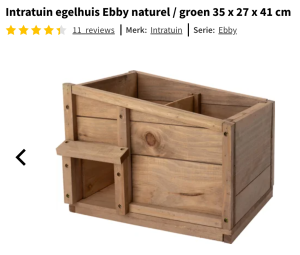
For a good-sized hedgehog, please see the section with how to make your own. Even if you don’t make your own, you will get an idea of size of the house. Generally, that’d be a minimum of 45 by 45cm for the internal part of the house, excluding the tunnel to it. And a tunnel leading to the house. If you buy a house with an integrated runnel like the one above, the sleeping compartment must be at least 45x45cm. And the height should be at least 30cm.
Who to contact if you find an injured or ill hedgehog
In The Netherlands
- Animal Ambulance (Dierenambulance)
- Check out here the number of the dierenambulance in your city: https://www.dierenbescherming.nl/afdelingen/ambulance
- Hedgehog rescue centers (Egelopvang)
- Check out here the number of the rescue centers in/around your city: https://www.egelbescherming.nl/dier-in-nood/adreslijst-egelopvangcentra/
- Facebook Groups for general advice
- Egelbescherming (Hedgehog protection Nederland): https://www.facebook.com/Egelbescherming
- Egelliefhebbers (Hedgehog lovers): https://www.facebook.com/groups/1059146134587896
In Bulgaria
- Фондация “Дивите Животни” / “Wild Animals” Foundation
- При намерено животно, изпратете снимки и видео на съобщение през фейсбук страницата им: https://www.facebook.com/DiviteJivotni
- За информация и съвети за различни видове животни, можете да прочетете тук: https://wildanimals.bg/adviceslist
- За да им помгнете финансово, вижте тук: https://wildanimals.bg/donation/finances
What to keep an eye out for once you have a hedgehog?
How to safely pick and keep a hedgehog until you bring it to a rescue center
Before we even go to what you should look out for, we need to talk about how to prepare for it. There are a few things to keep around:
- Always pick hedgehogs with thick, rubber gloves. They are not exactly clean animals, but also could have skin diseases that need to be treated and are not easy to spot with an untrained eye
- A deep cardboard box / or a plastic box, with holes for air. At least 40cm tall, hedgehogs are great climbers, so make sure to close it well once the animal is inside until you bring it to a rescue center.
- Some filling material, leaves are a great choice, so it can have some “darkness” by digging into them.
- Potentially, if it is cold outside or the animal is hypothermic, you can add a plastic bottle with hot water, always wrapped in a towel and slightly crushed so it doesn’t roll. This will provide some warmth should the animal need it. Place the bottle in one side of the box so that there is another part of the box where the hedgehog can go if it gets too warm.
Main things you to keep an eye on
Is my hedgehog male or a female?
If you need to rescue a hedgehog between early June and roughly September, please be extra careful. During this period, there is a chance that the hedgehog you have found is a mother with dependent young. Removing her from the wild could leave her babies without care, causing them to starve.
Before taking a hedgehog into care, try to determine whether it is male or female. Male hedgehogs have a visible penis, often described as looking like a “belly button”, located in the middle of the abdomen. In females, the vulva is much lower down and sits very close to the anus.
To check safely, gently pick up the hedgehog using both hands. Position one hand so the front paws are between your fingers and the other so the back legs are between your fingers. Carefully and gently encourage the hedgehog to unroll while supporting its body. Once relaxed, look at the underside and check for the presence of a “belly button” in the middle of the tummy. If it is present, the hedgehog is male. If it is absent and there are two openings close together near the tail, the hedgehog is female. (See the images below)
Always use thick gloves, hedgehog sometimes may bite! Nothing to worry about, except it may be painful unless you wear good gloves.

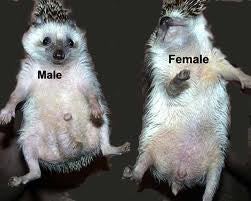 -> real image
AI-Generated image by me, matching the reality as close as possible but with better quality:

It sounds a bit gross but.. poop
The hedgehog poo is one of the main indicators of the health of the animal. Regular poop looks smooth, light brown in colour and good shape. Before falling into hybernatoin, the poop may become light green, lime colour, that may be OK, depending on the season and temperatures outside. If, however, you notice dark green poop or slime, then this can either be an issue with the hedgehog (internal parasites that need treatment), or may be OK if you have recently changed the food. Hegdehog’s stomachs are not very strong so sometimes this is normal. Observe the poop for a few days and if the green doesn’t stop, reach out for help with your local rescue center.
Weight
A healthy hedgehog must be minimum of 500g, preferably 600g to sustain and survive winter hybernation. If you find a smaller hedgehog than that around end of October or November, especially if you encounter a baby of 100-300g, please immeditely contact for a rescue of the animal. Pick it up and put it in a deep box with leaves and air holes for breathing until you get a chance to call and bring it to the rescue center.
Malnourished or dehydrated hedgehog
Hedgehogs can seem active and ok, but they can be malnourished or dehydrated even if they have the right weight. Below you can see that a healthy hedgehog will look round and plump, while a sickly and dehydrated one will appear more like a pear shape and looks skinnier around the toushie area. If you see the “pear” shape, please contain the hedgehog and call the nearest rescue center.
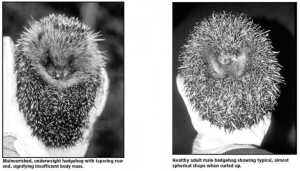
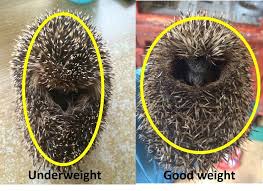
Any appearances during the day
If you see a hedgehog during the day, 90% of the time it needs urgent care. Please gently scoop up the hedgehog and call the nearest hedgehog or wildlife rescue center for help.
Exceptions
- In the summer, sometimes you may see a female hedgehog preparing to give birth and collecting leaves for her nest. She may appear in the early light hours of the day – 6-7AM and would disappear after. This can happen with females who have already given birth or those about to do it any moment soon. Always take it with a grain of salt though, when you see a hedgehog during the day.
- Sometimes young ones can roam around, but also just in case – call a wildlife center for advice.
Coughs
A hedgehog that coughs “like an old man”, usually has lungworm, a condition that would require intervention and treatment and is dangerous if not treated. Please contain the hedgehog and call the nearest hedgehog/wildlife rescue.
Hear here and here how a coughing hedgehog sounds.
Installing a camera
I use “Blink Outdoor 3” cameras, previously I have also used VicoHome cameras from AliExpress, super nice options. Blink is by Amazon and you can get a bundle of up to 4 cameras + sync module. The sync module is required and the cameras connect to it and on it, you can plug a USB for backup or you can pay a subscription of 10 eur per month for all your cameras or smaller amount per camera if you only have 1 or 2, for example. The subscription saves data to the cloud and makes it very quick and easy to review your footage. I use my cameras for hedgehogs but also for birds and, of course, as security cameras too.
Difference between a dead and a hibernating hedgehog
Hedgehogs always hibernate in a tight ball, you cannot see their head when they are in winter sleep. Their breathing is very very slow, often undetectable. Please NEVER throw them away before calling a specialist to ask. If you have accidentally disturbed a hibernating hedgehog, make sure to put him back gently and cover him with leaves. You see where the “clumps” of quills gather, this is the bottom side of the hedgehog, make sure to place him back with the bottom side down, of course.
A dead hedgehog often lays sideways, this is how we find them when sometimes they pass due to illness in the hedgehog rescue center, just like in the second photo below, or sometimes on their tummy, but never in a ball. This is a good way to distinguish a dead vs alive hedgehog.


Build your own house
Egelbescherming (Hedgehog protection foundation) organization in the Netherlands, has tested numerous houses on the market to see if they are good in size, waterproof qualities etc. They have found the perfect size and design for a house. This house, however, is quite expensive, so I would recommend you buying the wood and making it yourself. As long as you follow a few general rules, your should should be safe for hedgehogs:
- Minimum sizes of 45x45x30 WxDxH, excluding the tunnel
- Tunnel with an entrance size of 13cm
- a hole for ventilation in the top size of the house, size of around 1cm.
Below I am providing a PDF file with instructions but also the images from the PDF follow below, also providing the article, you can right click -> translate to Engligh to understand it if you are not a Dutch speaker.
- Instruction PDF: Egelbescherming Nederland hedgehog house instructions
- Article: https://www.gardenersworldmagazine.nl/groene-school/tuinklussen/egelhuisje-maken/
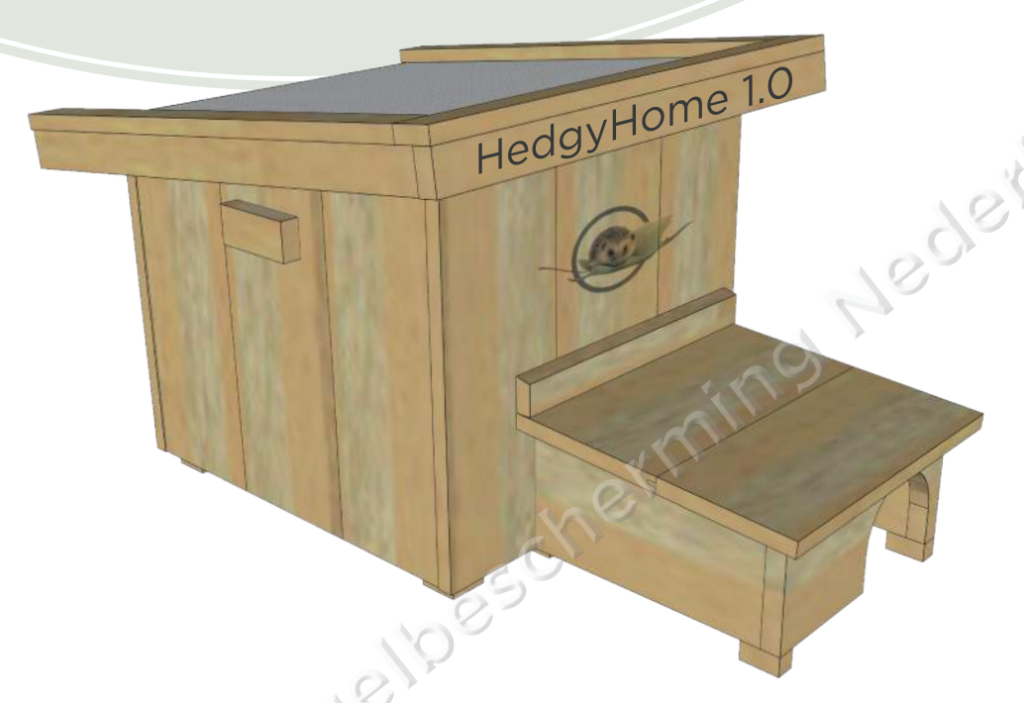
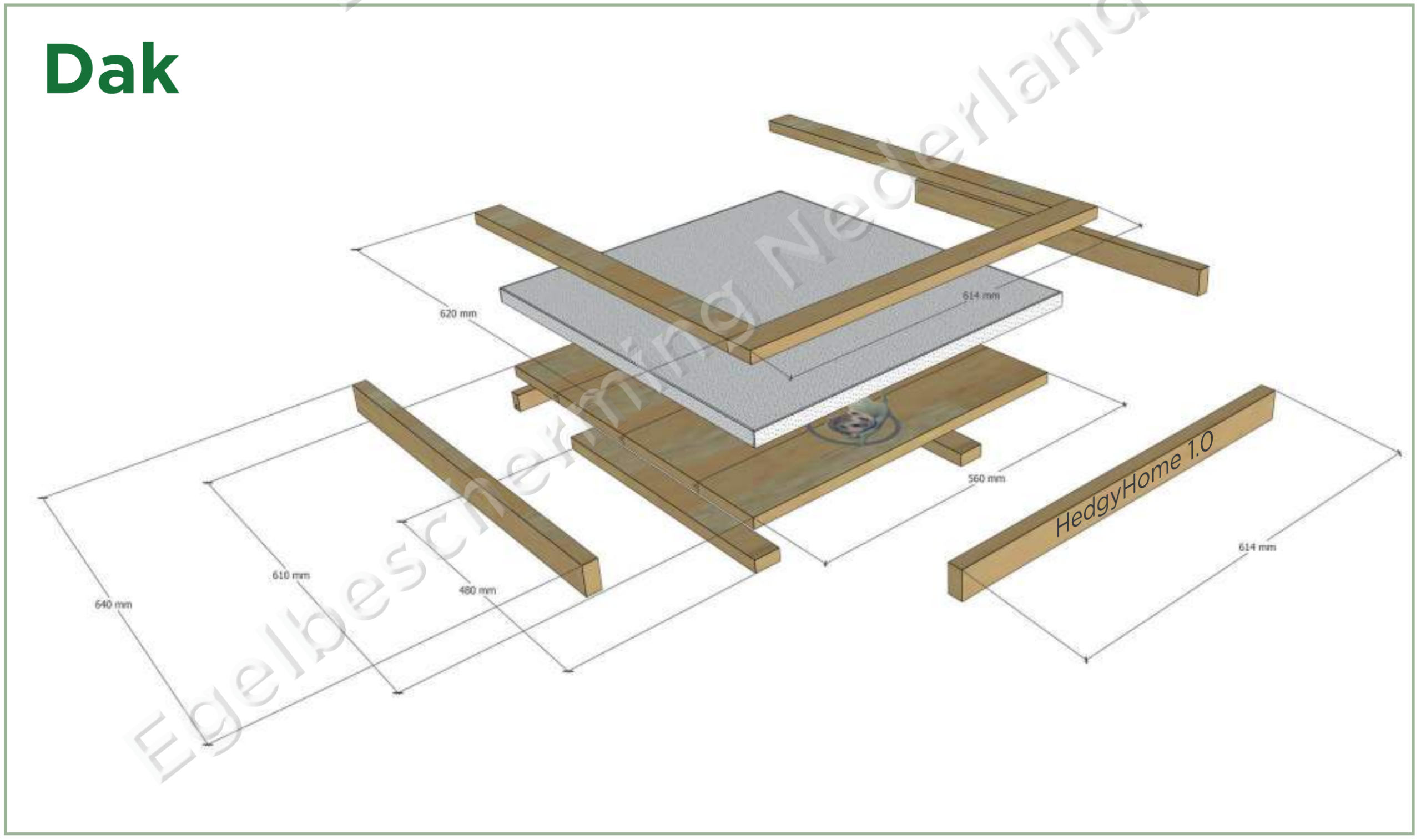
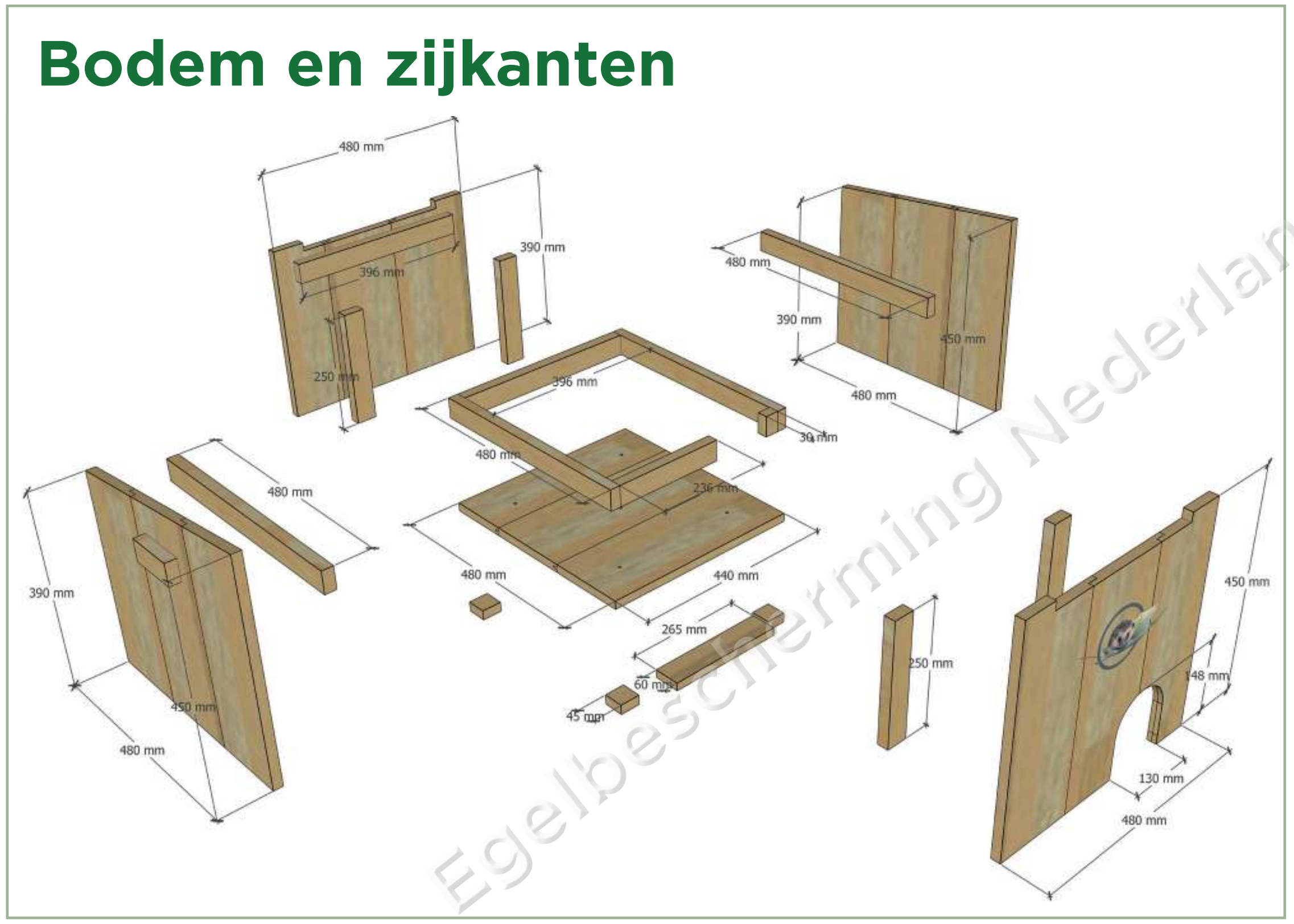
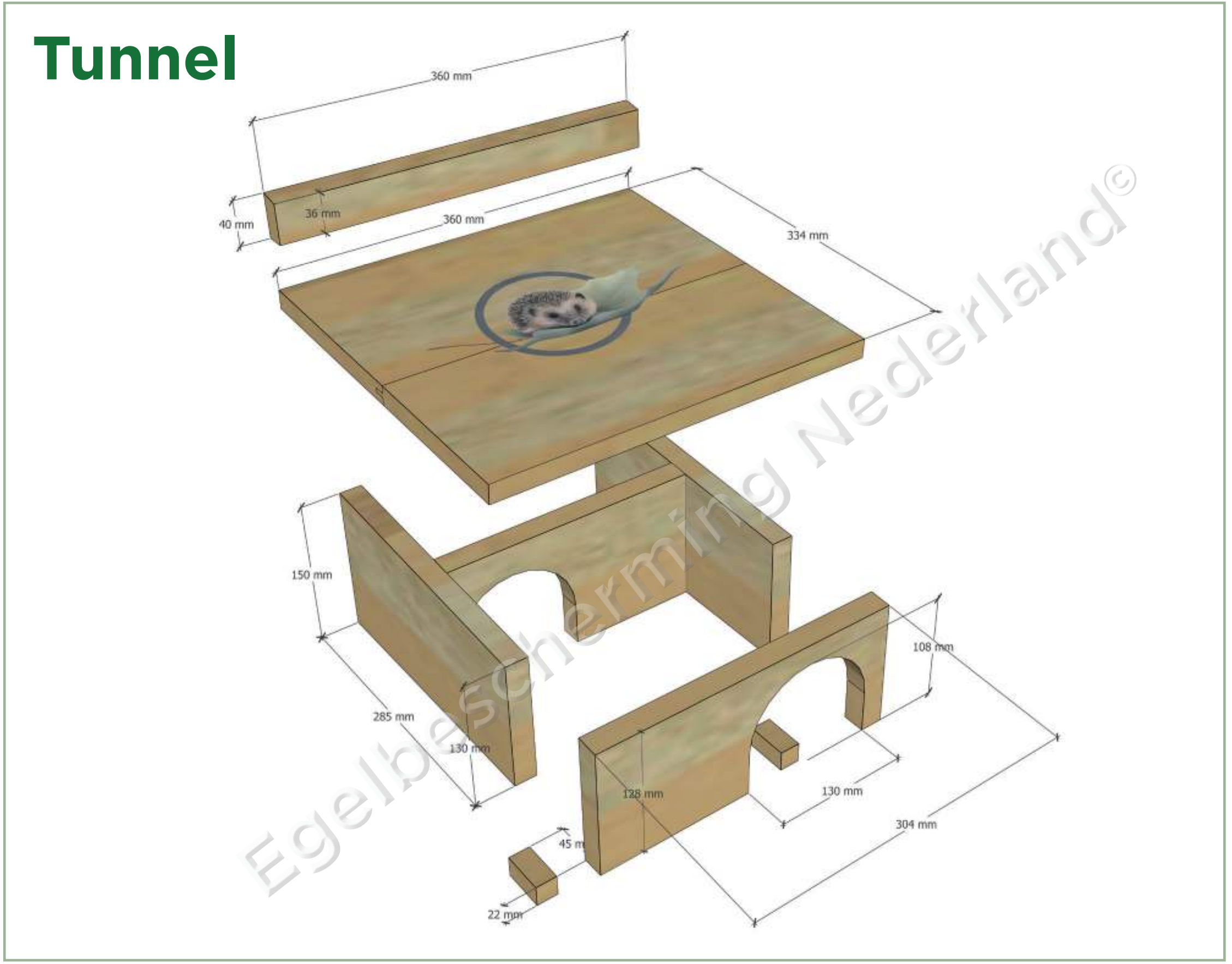
Where and how to place the house
Place the house with the entrance facing South – South-east. This prevents the house from getting cold wind inside. Hedgehogs like the wild areas of your garden, so to increase the chances of the house being occupied for the winter, place the house in a secluded, quiet, and more wild place of your garden. Fill the house halfway with leaves (make sure they are dry) and place more leaves around the house, the hedgehog that chooses it for its own, will add extra fillaments inside of it until it becomes so cramped that you’d not see anything if you’d open the house. That being said, do NOT open the house until spring and do not disturb the hedgehog’s sleep.
Clean the hedgehog house thoroughly in spring and after the baby season if it has been occupied for the summer too. When spring starts, wait until it’s constantly above 15 degrees (also during the night), so around April-May in North Europe, then carefully peek inside the house and make sure the hedgehog has left, throw away all old material, wash with green/bio soap and let the house dry well under the sun, fill up again half way with some fresh leaves and leave it be. I wouldn’t recommend hay or straw as they are dusty. What I do, is collect some extra leaves in fall to have enough for spring cleaning too.
NB! Do NOT paint the house with any sort of paint! It can be toxic!